
The Extra Mile: Drone Club

At 8 years old, Charles Malé ’25 had his eyes set on flight. “I’ve always loved drones, helicopters, and anything that moves,” he said.
He spent years playing with toy cars as a child but eventually got bored with them. Moving onto toy helicopters, he finally landed on his true passion: drones.
Malé, assistant cadet in charge of the VMI Drone Club, is a computer science major with a minor in cybersecurity, from Arlington, Virginia. Malé came to VMI with an associate’s degree in computer science and he plans to graduate early in 2024.
“I’ve done a lot of work with drones over the years,” he said. “But they were quite expensive.” The cost of flying drones and professional gear can reach upwards of $1,000. Due to the expense of drones, Malé decided to take a break from his hobby.
Luckily for Malé and other cadets at Â鶹ŮÑÝԱ Institute, Dr. Sherif Abdelhamid had other plans for the Drone Club at VMI.
Abdelhamid, assistant professor in the Department of Computer and Information Sciences, received a grant from the Commonwealth Cyber Initiative. Abdelhamid leads VMI’s Drone Club and has a fellowship from CCI that he uses to sponsor research and cadet development.
More importantly, he has used the grant to sponsor all the Drone Club’s activities. “Using the grant, we have bought around ten drones of different types, sizes, and purposes, as well as other IoT devices and sensors,” he said.
While attending a cybersecurity event, Abdelhamid became interested in drones and the role that they play in surveillance and protection. “The drones are no longer just flying toys,” he said. When asked if he would support the Drone Club, Abdelhamid thought it would be a great way to apply his personal and research interests to a cadet involvement opportunity.
Last year, Malé was approached by Abdelhamid. “He knew I was into drones… we were talking about it in class one day,” Malé said. “He was like, ‘Oh you seem to be into drones.’”
Malé had no idea that a Drone Club even existed at VMI. With little hesitancy, Malé joined forces with Abdelhamid and the two cadets –in charge, Kolby Quigg ’24 and Stone Summers ’24, to reignite the club.
The club has a membership total of three to five cadets. Most members of the club are computer science majors. This common trait presents difficulties when cadets have overlapping group study sessions and cannot make it to the club meeting time.
To accommodate the club’s demographic, and attract cadets from other departments, the club rearranged its schedule to host meetings on Mondays. “We’ve noticed a bigger turnout since then,” Malé said. “Next semester, we’re expecting to see at least five people consistently.”
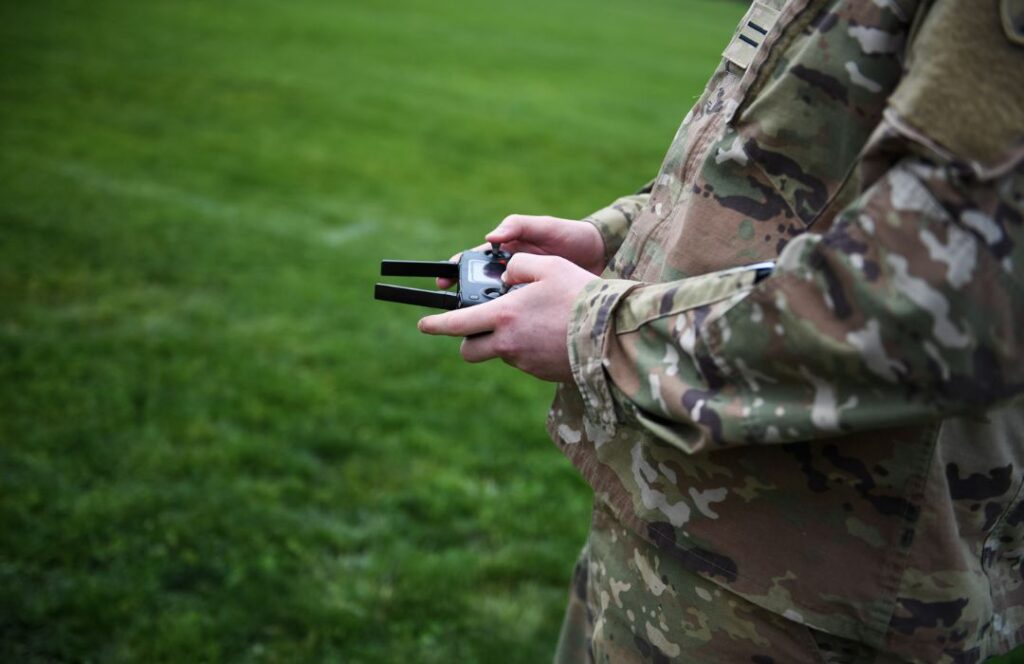
Simulating flight
Since the Drone Club had previously existed, the first step for the group was inventory – “We went on a treasure hunt for leftover drone parts,” said Malé.
“We had to see what kind of drones were left behind and we found this really old brand called 3DR Solo,” said Malé. The club spent its first semester trying to update the software and firmware on these old-school drones.
The software updates did not make a major difference, and the club moved on to purchasing DJI Phantom 3’s. Through this time, the club realized they were using a lot of large drones and ones that many cadets may be unfamiliar with. When the club came to this realization, Malé had an idea that would transform the club.
“I introduced the idea of having people come in [to the club] and use my drone simulator,” he said. The Drone Club meets later in the day, around 8 p.m., and has had issues with flying at night.
“So, we switched to simulators for the meantime, while we figured out the big drone situation,” said Malé.
In addition to the drone simulator, the club has recently tapped into educational drones. Malé explained that the club is using educational software through a program known as “DroneBlocks.” The software uses visual programming concepts to help students learn to program drones, irrespective of their programming experience level.
“We’ve been relying on their [educational] drones as a big resource for the first semester, as well as second semester,” said Malé.
When looking to buy a drone, there are many classes to consider. Malé shared that there are educational-sized drones, racing-sized drones, indoor drones, and outdoor drones.
Drone credentials and certifications
To be considered “street-legal,” it is required to register drones that are over one pound. To register a drone and legally fly it, an individual must obtain a license from the Federal Aviation Administration (FAA). In addition to licenses and registrations, cadets in the drone club must work with post-police to make sure that they are following all airspace guidelines.
This summer, the club hopes to increase its membership and will do so by sponsoring cadets to obtain their FAA licenses.
“We’re going to sponsor cadets and faculty to apply for the FAA certificate,” said Abdelhamid. The club sent an email to all cadets informing them about this opportunity and has since received six applications.
“We are planning to sponsor up to 10 cadets,” he said. Abdelhamid plans to use his grant to cover the test fees, study materials, and travel expenses for all interested cadets and faculty members.
Aside from certification, the club has hopes of attending a drone competition soon. Next fall, the club plans to attend a gated drone competition, with teams competing from several different departments on post.
Before then, the club received an invitation to participate in community cyber day May 13 in Natural Bridge.
“On this day, we plan to showcase the work we are doing, the activities, and the drones we have,” said Abdelhamid.


