
The Extra Mile: Brazilian Jiu-Jitsu Club

Cadet Audrianna Kelly ’25 had never heard of jiu-jitsu prior to coming to Â鶹ŮÑÝԱ Institute. Previously doing martial arts, kung fu, karate, and wrestling, she was looking for a way to stay active while on post.
That’s when she found VMI’s Brazilian Jiu-Jitsu (BJJ) Club as a rat. She aspired to get physically stronger and find more ways to defend herself to help aid her in her future military career.
“As soon as I got the list of clubs that were available, and I saw Brazilian jiu-jitsu I was immediately intrigued,” she said.
Jiu-jitsu is a grappling-based martial art and combative sport, which uses skill and control to resist opponents. It also serves as a form of self-defense.
Kelly is one of the few females in the club. Out of the nearly 50 people in the club, only five are female.
“I think that being one of the few females in the club is cool because it goes along with the saying, ‘Women can do anything a man can do, but in heels,’” she said.
Sparring with guys doesn’t bother her, because they’re all there to learn martial arts and to become strong. But she’s noticed some guys don’t want to spar with the girls.
“I guess because most of them are either physically bigger than us or more skilled, and they don’t want to hurt us. I don’t like that thought process because, while it is sometimes true, it leads to a clear line that separates the guys and girls of the club that is ultimately putting a damper on our training,” she said. “When guys don’t want to spar with girls, it leaves us girls to spar with each other and there is no variety, no change. Overall, I don’t mind when I spar with guys or girls.”
Coach Col. Paul R. Moosman, Jr. started BJJ because of his wife, Deanne, who happens to be the assistant coach for the club.
“I got into jiu-jitsu because I needed to learn how to protect myself against my wife who was also learning,” he said. “And I think we both got into coaching because we got connected with the club early on.”
“Paul felt like he couldn’t just let me do jiu-jitsu and beat him up, so he started to take jiu-jitsu classes with me,” Deanne joked.
The club started in 2009 with Capt. Jim Whitten as the coach. The Moosmans got involved around 2015, then officially became coach and assistant coach two years ago. Both are purple belts — the third level, with belt ranks going white, blue, purple, brown, and black.
Deanne said she got involved with jiu-jitsu after taking boxing classes and Muay Thai. She was familiar with jiu-jitsu because there are combative (classes) in the Department of Human Performance & Wellness, where she works.
She loved the physical and mental components of the sport. Jiu-jitsu is like a game of chess on the mats where you have to anticipate your opponent’s moves.
“When you’re rolling with someone, you can bait someone to set something up like you can in chess,” she said. “You can think like two, three, or four moves ahead and set things up.”
Deanne said by the time participating cadets graduate, they should be able to think two moves ahead.
“There’s an aspect of you getting comfortable being uncomfortable,” she said. “So you’re in a difficult position or situation and you really have to maintain your composure and think through that situation strategically.”
It also doesn’t matter your size or weight — if you have your techniques down, you can go up against anyone, Deanne said.
“You can go up against someone who’s like 50 pounds heavier, a lot heavier than you, stronger than you and you can use the technique to out-technique them.”
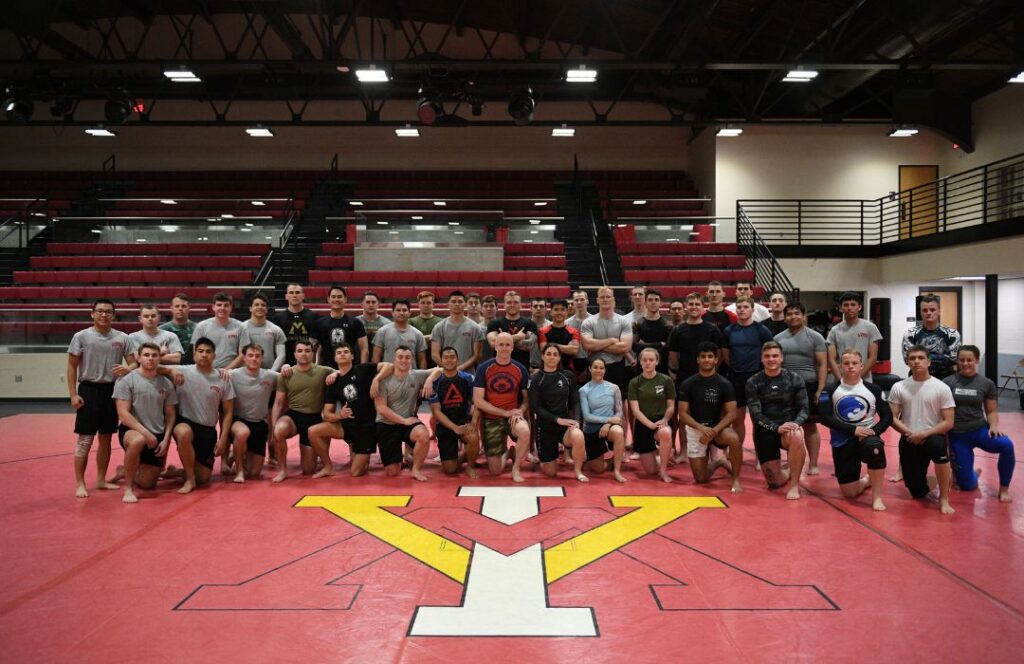
Practice and dedication
Club members practice two to three times a week, totaling about five hours a week.
Cadet Walker Powell ’23, cadet in charge of the club, signed on as a rat, along with his roommate David Amos ’23, the assistant cadet in charge. Both are blue belts.
The club also competes in several competitions throughout the year. Both Powell and Amos participate in those, along with about a dozen more.
“I just wanted to be good at something unique. Then I started doing it; I just fell in love with it,” Powell said.
It takes persistence and dedication. Powell said it can take up to 20 years to accomplish a black belt — a longer timeline than most martial arts. Powell and Amos say at their respective home gyms they may dedicate about 15 to 20 hours a week to practice.
Powell echoed the notion that jiu-jitsu is like chess.
“You can’t get good at a strategy or position unless you work it as often as possible,” he said. “You can’t really work these things out like chess where you can play by yourself. You have to have that other person with you. So, it may not seem like a team effort, but it really is a team effort to do the sport.”
For some, it’s not about competition, it’s more about the workout and release.
“It’s like a workout in that afterward you feel exhausted but good, confident about yourself. Or when you’re sad or mad about your day, this is a great way to let it out,” Kelly said.
Cadet Holly Hein ’23 is preparing to commission into the Marine Corps. After leaving the VMI swim team to focus on ROTC, she was able to join a club she wanted to. It also didn’t hurt that she’s had martial arts experience — she’s a black belt in Taekwondo.
“I like the skills that I’m learning. It’s a lot of self-defense skills, but it’s also useful,” she said. “I’m going to the Marine Corps and we have a Marine Corps martial arts program that uses a lot of jiu-jitsu and Judo techniques. So, I’m getting some background experience in that. And it’s also a really great de-stressor. Mondays and Wednesdays, I know that I’m going to go there and I’m going to get all of my frustration from the day out.”
Paul said he loves seeing the cadets grow with the club.
“It’s great to have your students outside the classroom,” he said. “It definitely makes it good for us because we can really connect with them. We’re not always seeing them in the classroom and you just kind of get to interact with them in a different way and you get to know them better.
“As a cadet, you come in and you know nothing so we practice two days a week, at the most maybe three days a week. It just takes a long time to sort of pick up the basic skills,” he added. “It’s really impressive to us when cadets are able to graduate from white belt to blue belt, which is a major milestone.”
Most recently, the club took five cadets to Charleston, South Carolina for the Annual WVGO Gi and No Gi Spring Championship bringing home several awards.
“This week we’ll be addressing weaknesses I saw in all of their games,” Paul said. “This is one of the reasons we encourage cadets to compete — it provides invaluable feedback on one’s technical abilities. By addressing the issues that reveal themselves in the high stress environment of a tournament, you can become a much better BJJ practitioner.”


