From the Himalayas to the Appalachians: Cadets Explore Culture and Tradition at China Folk House

The house of a Tibetan Catholic family was built near Cizhong, China in 1989. With a blend of Tibetan, Naxi, Bai, and Han Chinese ethnic styles, the home follows traditional layout, materials, methods, and ornamentation of houses in the region going back centuries.
In 2017, the house had to be relocated due to the construction of the Wunonglong dam. Now calling Harpers Ferry, West Virginia, home, the China Folk House is along the Appalachian Trail connecting to the Shenandoah River, echoing its previous landscape of the Himalayas and Mekong River in China. What started out as a simple teatime at the home in China, turned into having the house disassembled and shipped over to the United States.
.
Sitting on a 1,600-acre nature conservatory as part of the Friends Wilderness Center, the home is a cultural and educational center dedicated to environmental stewardship, cultural exchange, community engagement, and experiential education, according to its website.
The China Folk House was the perfect place for 15 Â鶹ŮÑÝԱ Institute cadets from Chinese Civilization, Introduction to Advanced Chinese, and Cultural History of Chinese Martial Arts classes to visit.
The trip was planned and organized by the Phi Sigma Iota Honor Society, the National Collegiate Chinese Honor Society, VMI’s Department of Modern Languages and Cultures, and Department of History.
Three faculty members oversaw the visit: Dr. Laura Xie, associate professor of Chinese and faculty advisor for Phi Sigma Iota Honor Society; Dr. Lu Lu, assistant professor of Chinese and faculty advisor for the National Collegiate Chinese Honor Society, and Dr. Qiong Liu, assistant professor in the history department.
The group of professors had learned about the home from colleagues at other universities who had visited it, and the founder of the China Folk House presented it at a Chinese pedagogy workshop they had attended.
Xie said it was an enriching and one-of-a-kind experience for the cadets, allowing them to engage directly with artifacts, architecture, and lifestyles that embody the history and culture of traditional Chinese society. She said during the visit, one of the founders explained the China Folk House was reconstructed to reflect the spirit of old rural China.
“She explained that the Folk House was built in the style of traditional farming villages, where neighbors worked together, supported one another, and tackled projects as a community,” Xie explained. “This gives our students a sense of how community bonds and shared responsibilities shaped traditional Chinese lifestyles.”
Xie and others said the excursion allowed cadets to explore the Chinese culture that can’t be covered in a typical classroom setting.
“To be honest, cadets don’t often have opportunities to experience Asian cultures locally in Lexington,” Lu said. “Excursions like these allow them to immerse themselves in foreign cultures and languages, even if only briefly.”
The visit provided hands-on examples of certain themes covered in class, from traditional construction techniques to symbolism.
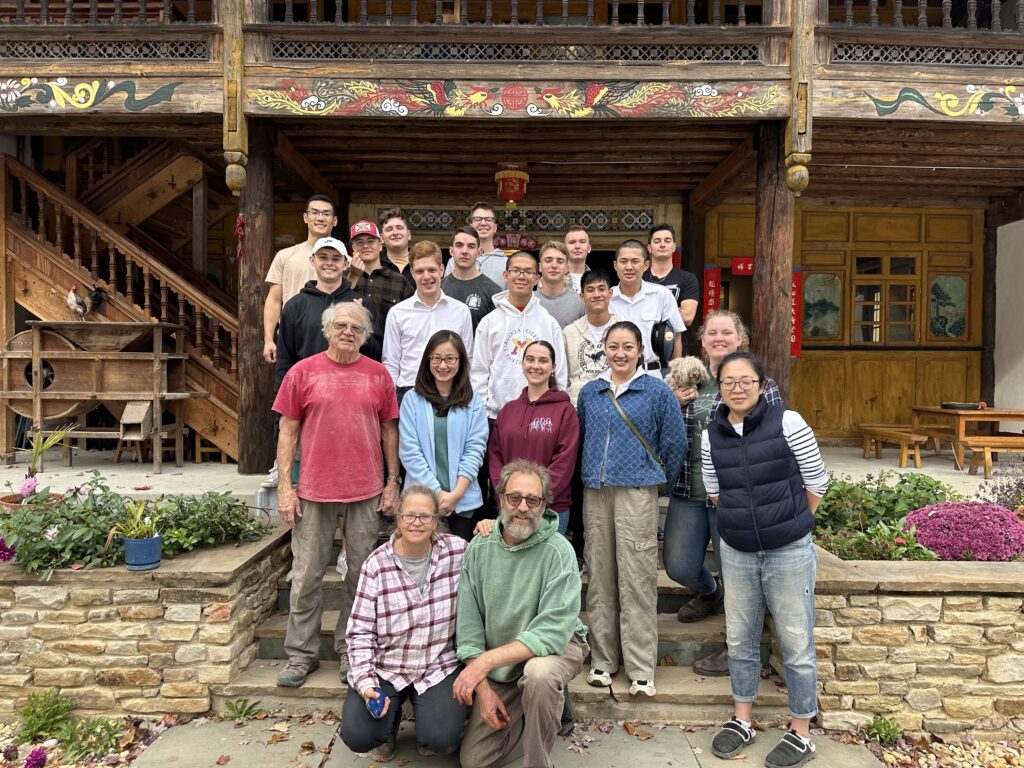
“The highlight of the trip was the cadets’ active involvement in the house construction process itself, and I was especially impressed by their teamwork and camaraderie, a true reflection of VMI’s spirit,” Lu said. “I believe this trip bridged the gap between classroom knowledge and real-world application and offered our cadets invaluable memories.”
Liu’s class, The Cultural History of Chinese Martial Arts, covers not only the techniques of Chinese martial arts, but also the cultural meanings within the practice.
“For example, Daoism — a philosophy deeply intertwined with Chinese martial arts — emphasizes harmony between humans and nature,” she stated. “The China Folk House beautifully embodies this principle in its design and integration with the natural surroundings. Traditional Chinese architecture, often influenced by feng shui, reflects Daoist cosmology, aligning spaces for balance and positive energy.”
By exploring the layout and architecture of the Folk House, it allowed cadets to experience the principles like harmony, balance, and simplicity, Liu explained.
“This experiential learning deepened their understanding of concepts they may have only encountered in texts, revealing how abstract ideas like yin-yang and feng shui come to life in physical spaces,” Liu commented. “The visit offered a tangible link between philosophical concepts, such as naturalness, and everyday practices, illustrating that philosophy isn’t just theoretical; it shapes practical aspects of life, from martial arts to architecture. Observing these principles in action helped the cadets appreciate how cultural philosophies influence daily experiences and lifestyle choices.”
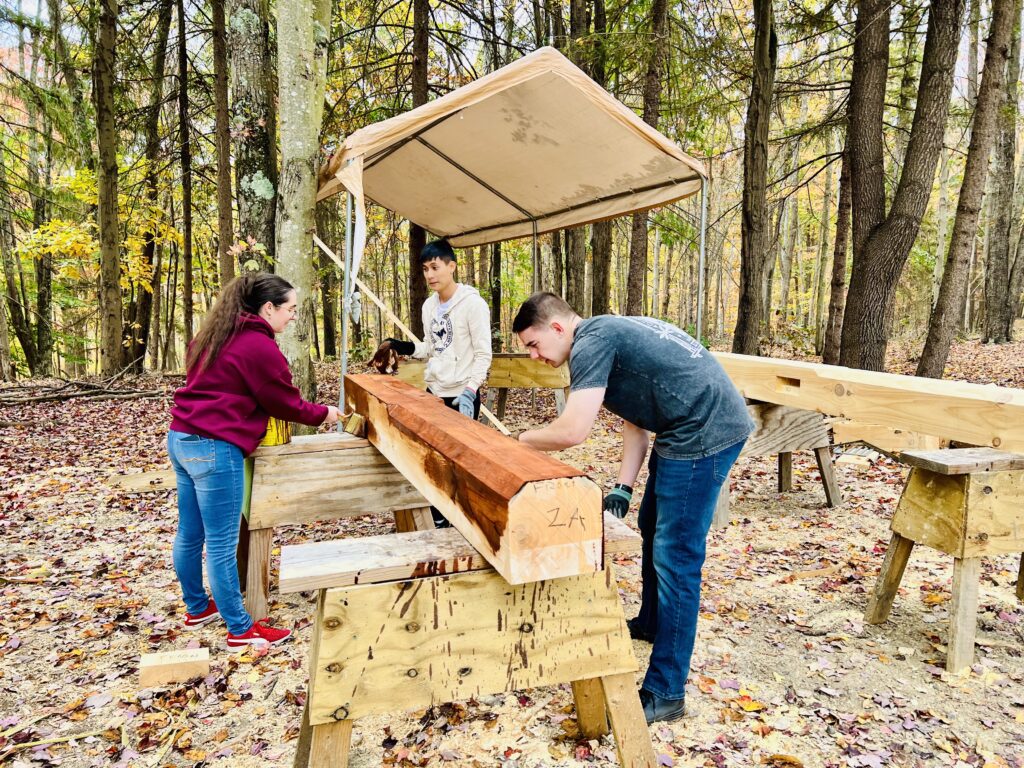
Anna Yemelianova ’25, the president of Phi Sigma Iota, found the experience meaningful because she and others were able to contribute to work at the home like staining wood, mixing concrete, and tending to gardens. It also provided a window into rural life and the transformation throughout China’s reform periods.
“Each space within the home told its own story — from the traditional kitchen that witnessed countless family gatherings to storage areas that reflected changing agricultural practices across generations,” she said. “As urbanization and modernization spread globally, preserving spaces like this becomes increasingly vital for maintaining connections to local knowledge and cultural traditions.”
The Folk House serves as a museum piece and a living bridge between past and present allowing visitors to see how rural families adapted to social and political changes, according to Yemelianova.
“Through both learning and volunteering, our group of VMI cadets became part of this ongoing story of cultural preservation, helping ensure these invaluable traditions and knowledge continue to be shared with future generations.”